Healthcare schemes work best when the right member receives the right service at the right time, with stronger verification, fewer disputes, and clearer accountability across providers, employers, and insurers.
Many healthcare systems still rely on physical membership cards or manual identity checks that can be vulnerable to impersonation, card sharing, or administrative errors.
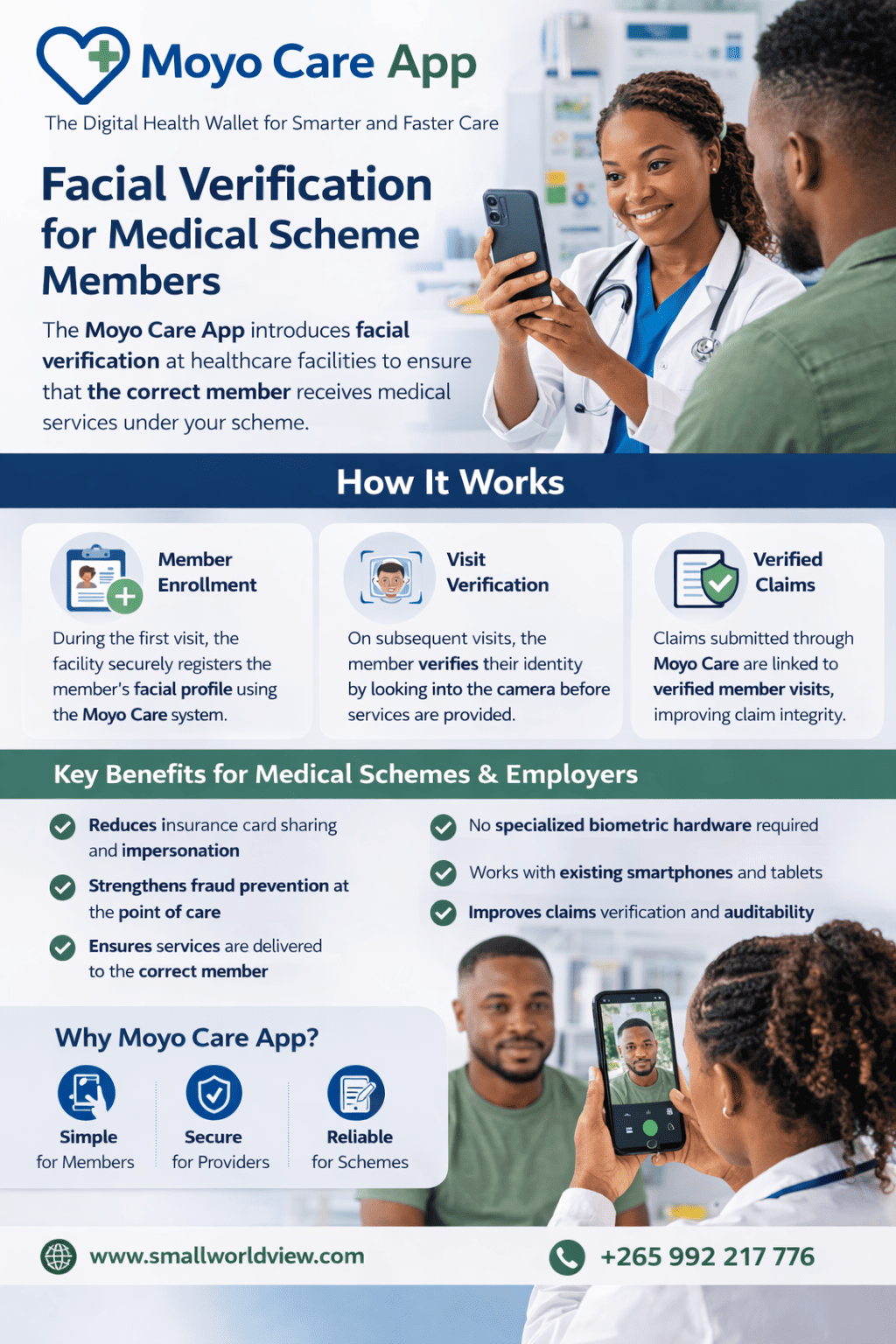
The Moyo Care App introduces facial verification for medical scheme members, helping healthcare facilities confirm patient identity at the point of care using existing smartphones and tablets. By combining biometric verification with digital care workflows, Moyo Care helps schemes, employers, and providers strengthen claim integrity while maintaining a smooth patient experience.
This approach improves confidence in healthcare delivery while supporting efficient processes for facilities, scheme administrators, and employers.
With the Moyo Care App, identity verification becomes a practical and seamless part of the care journey.
During the first visit, the healthcare facility securely enrolls the member’s facial profile as part of the digital patient record.
On subsequent visits, the member verifies their identity by looking into the camera before services are provided. This step helps ensure that the correct scheme member receives consultations, tests, procedures, and medicines under their scheme.
Because verification happens within the clinical workflow, facilities can improve security without introducing unnecessary delays for staff or patients.
Traditional biometric systems often require dedicated scanners or specialized hardware that can be expensive to deploy and maintain. Moyo Care takes a more practical approach.
Facial verification works with existing smartphones and tablets already used in healthcare facilities. This allows providers to add biometric identity confirmation without significant new hardware investment.
By using devices already available at the point of care, Moyo Care makes digital verification more accessible, scalable, and easier to adopt.
Medical schemes often face the challenge of members sharing cards or unauthorized individuals attempting to access healthcare services under another person’s scheme membership.
Facial verification helps reduce this risk by confirming that the person presenting for care is the same person enrolled under the scheme.
This strengthens confidence that:
By improving patient identity verification at the point of care, schemes and providers can strengthen both accountability and trust.
Because facial verification occurs before services are delivered, claims submitted through the Moyo Care system can be linked to verified member visits.
This creates stronger audit trails and improves confidence in healthcare claims for schemes, employers, and providers.
Verified claims help organizations:
By connecting identity verification to digital care and billing workflows, Moyo Care helps create a more reliable and transparent healthcare financing environment.
Employers and HR teams responsible for employee healthcare benefits gain additional assurance when member identity is verified at the point of care.
Facial verification adds a practical layer of accountability while keeping access to healthcare smooth and efficient for employees and dependants.
Healthcare facilities using the Moyo Care App gain a practical way to verify patient identity without disrupting care delivery.
By integrating identity verification directly into the care process, providers can improve both efficiency and accountability.
Stronger healthcare systems are built on accurate information, trusted processes, and better coordination between patients, providers, employers, and schemes.
Facial verification supports this vision by ensuring that care, billing, and claims all begin with confirmed patient identity.
With the Moyo Care App, healthcare providers can combine digital care delivery, automated claims workflows, and biometric verification into one connected platform, creating a healthcare ecosystem that is more secure, more transparent, and better aligned with the needs of all stakeholders.