
Published by Moyo Care - 21 April 2026
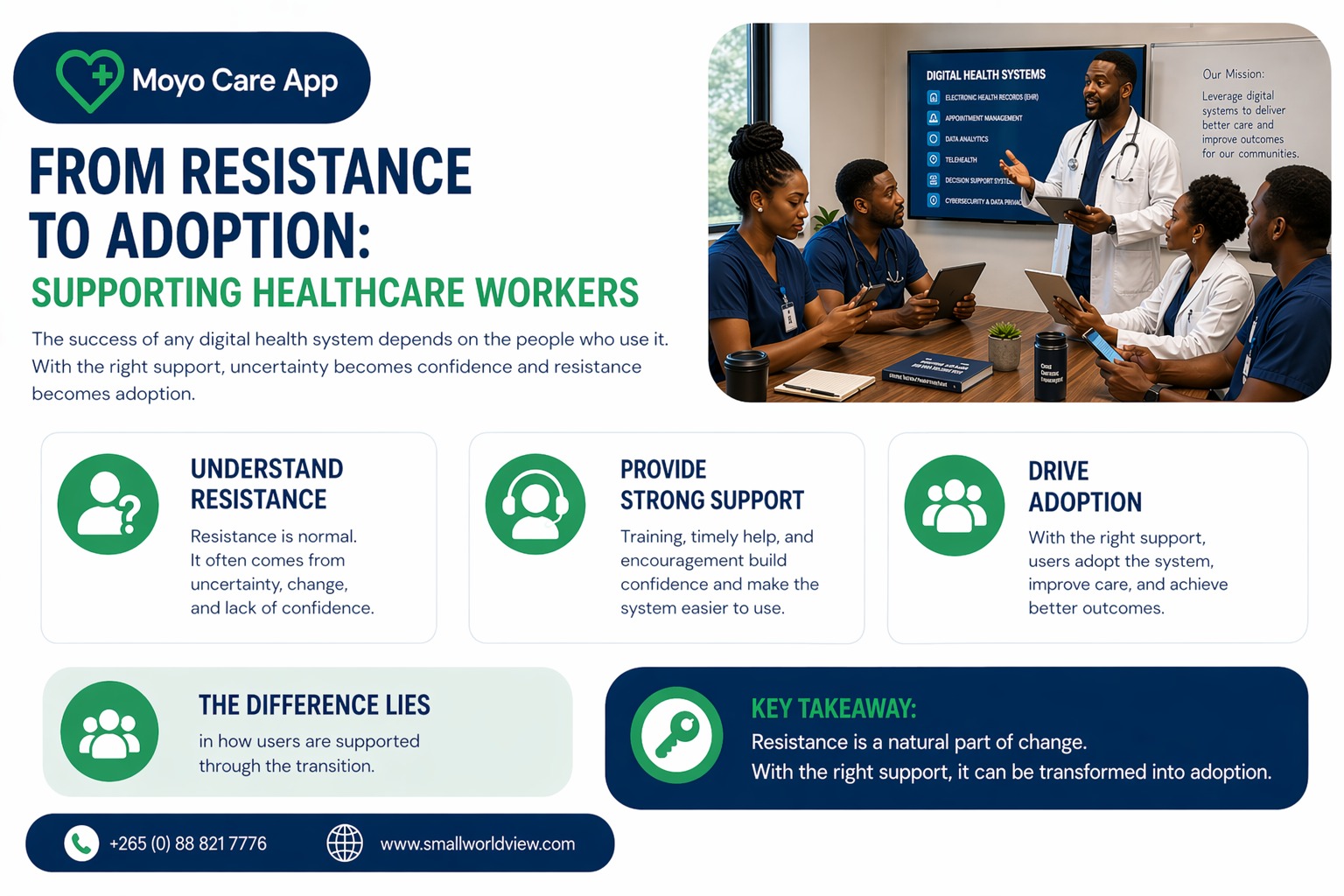
Resistance to digital systems is rarely about refusing change. More often, it reflects uncertainty, pressure, and the absence of timely support.
The success of any digital health system depends on the people who use it.
While systems may be well designed and technically sound, adoption is ultimately driven by healthcare workers. Their willingness to use the system consistently determines whether it becomes part of daily operations or is gradually ignored.
In many cases, resistance is not caused by unwillingness to change. It is driven by uncertainty, pressure, and lack of support.
Healthcare environments are fast paced and demanding. Staff are expected to deliver care efficiently while managing high patient volumes.
Introducing a digital system into this environment adds a new layer of responsibility.
Common concerns include:
These concerns are often unspoken, but they strongly influence behavior.
It is important to recognize that resistance does not mean users are rejecting the system.
In most cases, it means:
When these factors are not addressed, resistance grows and becomes long term.
Resistance is rarely obvious. It often appears in subtle ways:
Over time, these behaviors reduce the value of the system and affect data quality, reporting, and financial processes.
Support plays a critical role in moving users from resistance to adoption.
Effective support does more than solve technical issues. It helps users feel confident and capable.
Support helps by:
When users know help is available, they are more willing to engage with the system.
Confidence is built through consistent positive experiences.
When users:
They begin to trust the system.
This trust leads to:
Adoption is also influenced by leadership within the facility.
When leaders:
Adoption improves significantly.
Support teams and facility leadership must work together to create an environment where digital systems are seen as essential tools rather than optional tasks.
Consider a facility where staff are introduced to a new digital system.
Without adequate support:
Over time, the system is used less frequently.
Now consider the same facility with strong support:
The difference lies in how users are supported through the transition.
Resistance is a natural part of change.
With the right support, it can be transformed into adoption.
Digital health systems are not just technical solutions. They are tools used by people in real clinical environments.
Understanding and supporting healthcare workers is essential for long term success.
In the next article, we will explore the financial and operational impact of poor support and how it affects the sustainability of digital health systems.