Published by Moyo Care - 6 May 2026
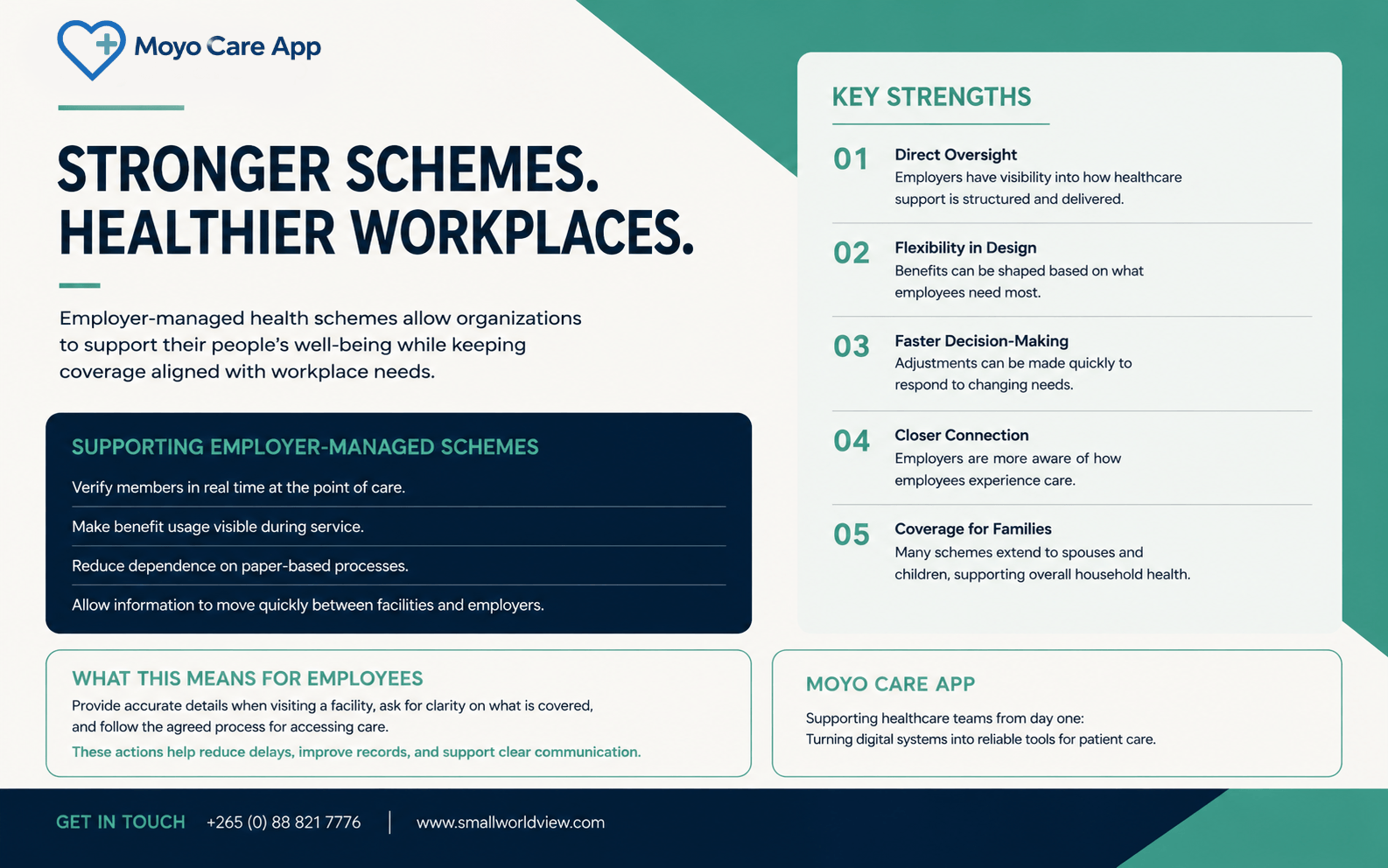
Employer-managed health schemes remain important because they allow employers to take an active role in supporting the health of their people while keeping the scheme aligned with workplace needs.
Employer-managed health schemes have been part of healthcare for a long time. Even as health systems continue to evolve, many employers still choose to manage healthcare support directly for their staff.
Over time, these schemes have grown. What began as support for employees often now includes spouses and children. Employees can access care across different facilities, depending on need and availability.
At the center of this model is a clear idea. The employer takes an active role in supporting the health of its people.
Employer schemes continue to be used because they offer practical advantages that align closely with how organizations operate.
Some of these include:
Employers have visibility into how healthcare support is structured and delivered. This allows decisions to be aligned with the needs of their workforce.
Benefits can be shaped based on what employees need most. This includes defining services, limits, and provider options.
Adjustments to the scheme can be made without going through long external processes. This allows quicker responses when needs change.
Because the scheme is tied to the workplace, employers are often more aware of how employees experience care.
Many employer schemes now extend beyond the employee to include dependents, supporting overall household health.
These strengths are part of why employer-managed schemes continue to operate in many settings today.
As employer schemes expand, new needs naturally come up.
Employers begin to focus more on:
In many setups, paper forms are still part of the process. These are used for approvals, tracking, or communication between facilities and employers. As the number of employees and dependents increases, managing paper becomes more difficult.
Reducing reliance on paper can help:
This is part of the natural development of employer schemes. It does not change the model. It strengthens how the model operates as it grows.
Structured systems can support employer schemes while keeping their core strengths.
This includes:
When information flows more directly, services can be confirmed faster and records are easier to manage.
Tools like Moyo Care support employer-managed schemes by introducing this kind of structure while allowing employers to remain fully in control of how their schemes operate.
Employer health schemes are designed to support you and your family. While the structure is managed by the employer, how the system works at the facility level is also shaped by everyday use.
Employees can support smooth service by:
These small actions help:
Over time, consistent use of the scheme in this way helps employers see where improvements may be needed.
In the next article, we will look at visibility and control.
We will explore how employers can: