
Published by Moyo Care - 15 April 2026
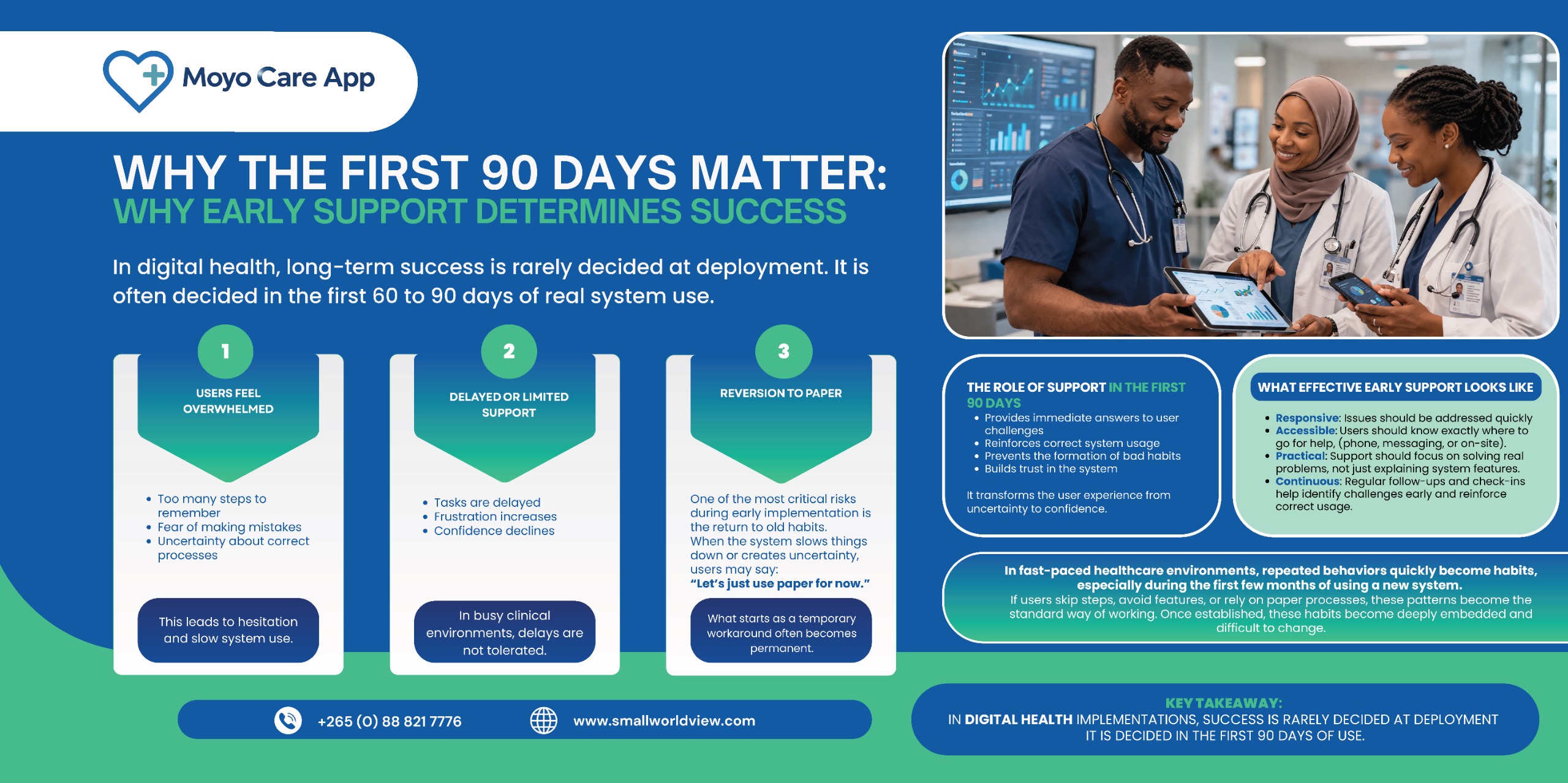
In digital health, long-term success is rarely decided at deployment. It is often decided in the first 60 to 90 days of real system use.
The success of a digital health system is often judged months or even years after implementation.
However, in reality, most systems succeed or fail much earlier — within the first 90 days.
While there is no fixed rule, experience across digital health implementations consistently shows that the first 60 to 90 days are critical. This is the period where users form habits, build confidence, and decide whether the system becomes part of their daily workflow.
When a digital system is first introduced into a healthcare facility, everything is new.
Users are learning new processes, navigating unfamiliar interfaces, and trying to balance speed with accuracy.
At the same time, patient care must continue without disruption.
This creates a fragile environment where even small challenges can have a significant impact.
If the early experience is positive, adoption grows. If it is frustrating, resistance begins.
Despite good intentions, several issues commonly arise during this phase.
Healthcare workers are often introduced to multiple features at once.
This leads to hesitation and slow system use.
When users encounter problems and cannot get immediate help:
In busy clinical environments, delays are not tolerated.
One of the most critical risks during early implementation is the return to old habits.
When the system slows things down or creates uncertainty, users may say:
“Let’s just use paper for now.”
What starts as a temporary workaround often becomes permanent.
Support during this period is not just helpful — it is essential.
Strong early support:
It transforms the user experience from uncertainty to confidence.
Healthcare environments are fast-paced and repetitive. Once a pattern is established, it becomes the standard way of working.
Behavioral research shows that habits take weeks to form, and often require consistent repetition over time. In real-world clinical settings, this aligns closely with the first few months of system use.
If users skip steps, avoid certain features, or use parallel paper processes, these behaviors quickly become embedded in daily operations.
Changing them later becomes significantly more difficult.
To ensure success in the first 90 days, support must be:
Issues should be addressed quickly — ideally in real time or within the same day.
Users should know exactly where to go for help, whether through phone, messaging, or on-site support.
Support should focus on solving real problems, not just explaining system features.
Regular follow-ups and check-ins help identify challenges early and reinforce correct usage.
Consider a healthcare facility implementing a digital system.
Without strong early support:
Over time, the system is seen as ineffective.
Now consider the same facility with strong early support:
The difference lies not in the system itself, but in the support provided during the early stages.
In digital health implementations, success is rarely decided at deployment — it is decided in the first 90 days of use.
As digital health systems continue to expand, organizations must place greater emphasis on the early stages of implementation.
Investing in strong support during this critical period ensures not only adoption, but long-term sustainability.
In the next article, we will explore how human behavior and resistance to change influence system adoption — and how support helps overcome these challenges.