
Published by Moyo Care - 27 April 2026
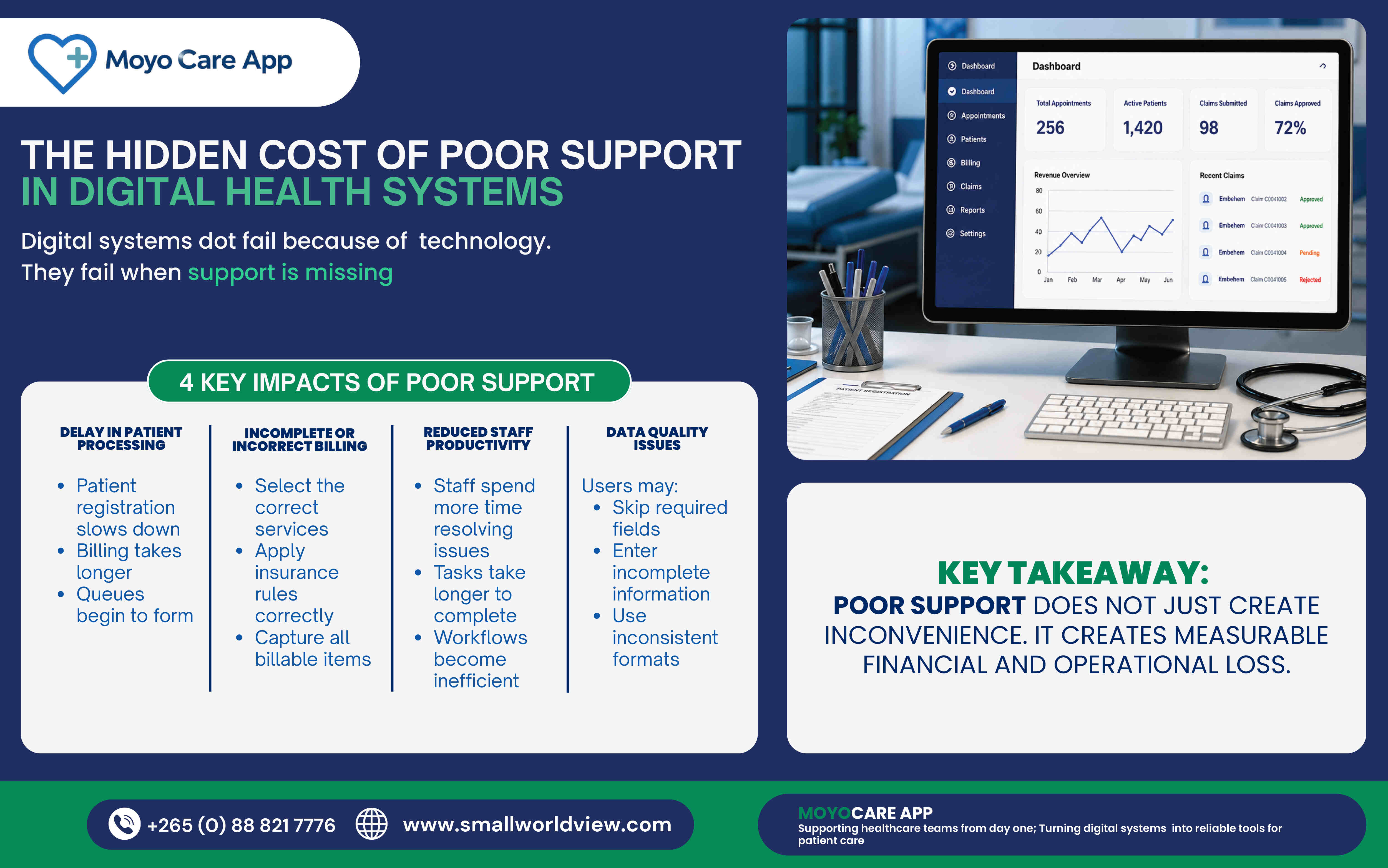
Poor support in digital health systems does not just create inconvenience. It quietly affects patient flow, staff productivity, billing accuracy, claims, data quality, and revenue.
Digital health systems are often introduced to improve efficiency, reduce errors, and strengthen financial performance.
However, when system and user support is inadequate, the opposite can occur.
The true cost of poor support is not always visible at first. It builds gradually through small inefficiencies, missed opportunities, and avoidable errors.
Over time, these costs become significant.
When discussing system performance, attention is often placed on uptime, speed, and functionality.
While these are important, they do not fully capture the impact of poor support.
The real cost is operational and financial.
It affects:
In busy healthcare environments, time is critical.
When users encounter issues and cannot get timely support:
This leads to:
Without proper support, users may struggle to:
As a result:
This leads to direct revenue loss.
For facilities working with insurance providers, accuracy is essential.
When support is lacking:
This results in:
Healthcare workers operate under constant time pressure.
When systems are difficult to use and support is not readily available:
This reduces overall productivity and increases frustration.
Poor support often leads to poor data.
Users may:
This affects:
Over time, the value of the system is diminished.
Perhaps the most significant cost is loss of confidence.
When users repeatedly encounter problems without resolution:
Once trust is lost, it is difficult to rebuild.
Consider a facility using a digital system for patient billing and insurance processing.
Without adequate support:
Now consider the same facility with strong support:
The system remains the same. The difference is the level of support.
Poor support does not just create inconvenience.
It creates measurable financial and operational loss.
As digital health systems become more central to healthcare delivery, support must be treated as a core component of the system.
Investing in strong support is not an added cost. It is a necessary investment to protect efficiency, revenue, and long term sustainability.
In the next article, we will explore how support directly influences data quality and why accurate data begins at the point of care.