
Published by Moyo Care - 20 June 2026
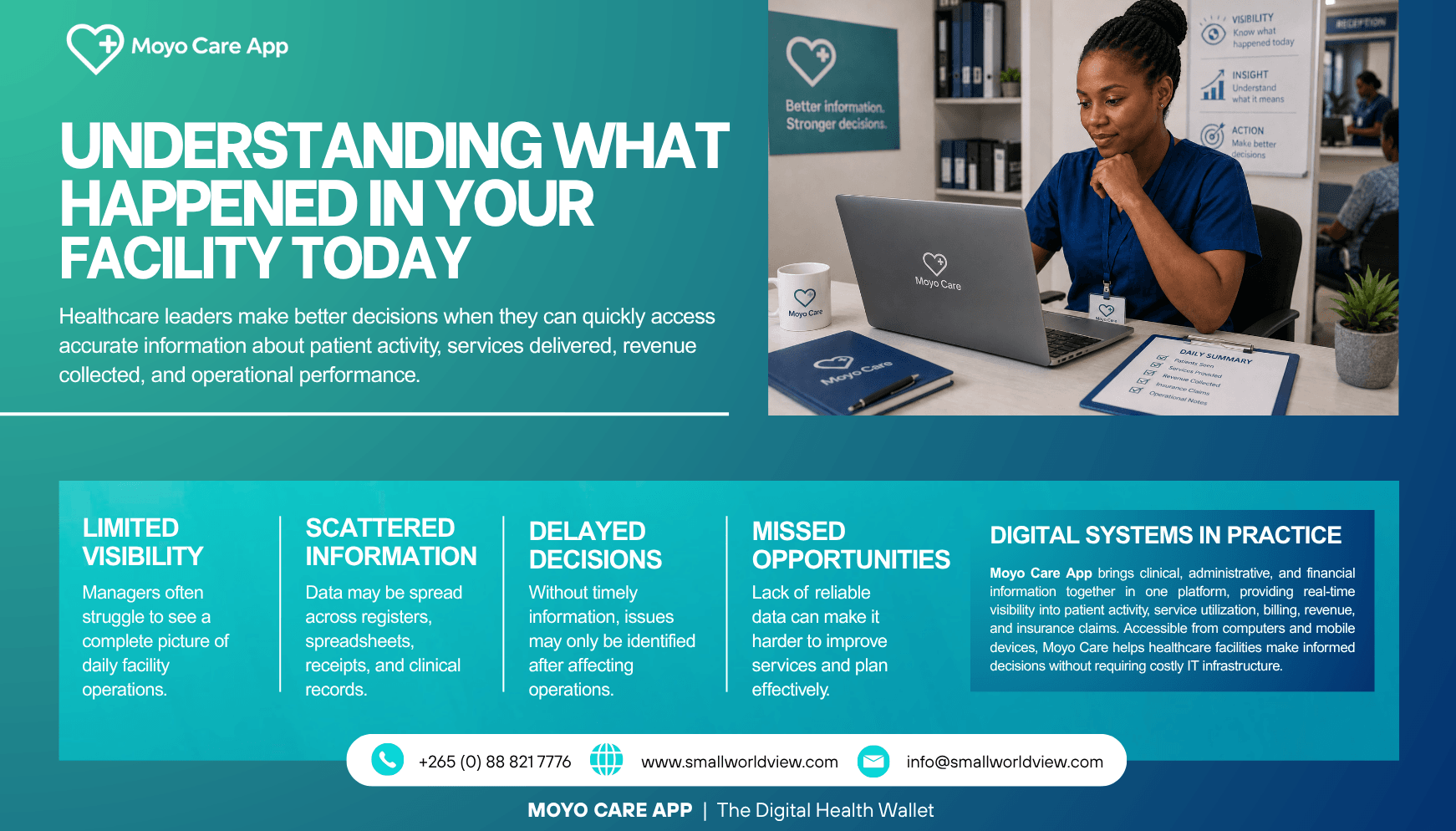
Effective management often begins with being able to answer a simple question: What happened in the facility today?
A clinic owner leaves the facility at the end of the day and heads home. Patients have been attended to, consultations completed, medicines dispensed, and the day's work appears finished.
The following morning, however, a different set of questions begins to emerge. How many patients were seen yesterday? Which services were most frequently provided? How much revenue was collected? How many patients were covered by insurance schemes? Were there any operational issues that require attention?
These are not unusual questions. They are the kinds of questions healthcare managers ask every day. Yet in many facilities, finding the answers is not always straightforward. Information may be spread across registers, receipt books, consultation notes, laboratory records, and spreadsheets. Gathering a complete picture of what happened can take time, and sometimes different sources tell different stories.
As healthcare facilities grow, the challenge becomes less about collecting information and more about making it useful.
A facility may only see a few dozen patients each day, but even at that scale, management decisions depend on having accurate information. Decisions about staffing, medicine procurement, finances, service expansion, and patient care all benefit from understanding what is happening within the organization.
Without visibility, managers often rely on assumptions or delayed reports. Problems may only become apparent after they have already affected operations. Opportunities for improvement may be missed because the information needed to identify them is not readily available.
This is why information is increasingly viewed as an operational asset rather than simply an administrative requirement. The ability to understand what happened yesterday, what is happening today, and what trends are emerging over time helps healthcare facilities make more informed decisions.
The healthcare facilities that often operate most effectively are not necessarily the largest or most technologically advanced. They are frequently the facilities that can access reliable information when it is needed.
Whether a clinic is serving twenty patients a day or two hundred, management visibility helps create stronger operations. It allows leaders to identify bottlenecks, monitor performance, understand service demand, and make decisions with greater confidence.
In many ways, effective management begins with being able to answer a simple question:
What happened in the facility today?
Many healthcare facilities are strengthening operational visibility through digital management platforms that bring clinical, administrative, and financial information together in one place.
Moyo Care App provides real-time access to operational information across a healthcare facility, including patient activity, service utilization, billing, and insurance claims. Because the platform is ready to deploy, implementation focuses primarily on configuring workflows to match the facility's operations rather than building new software from scratch. The system can be accessed through internet-connected computers and mobile devices without requiring dedicated servers or complex IT infrastructure. Moyo Care also supports integration with participating health insurance systems, helping reduce reliance on paper claim forms while improving the flow of information between facilities and healthcare financiers.
In the next article, we explore a situation that many growing healthcare facilities eventually experience:
When a Small Clinic Starts Feeling Busy