
Published by Moyo Care - 30 June 2026
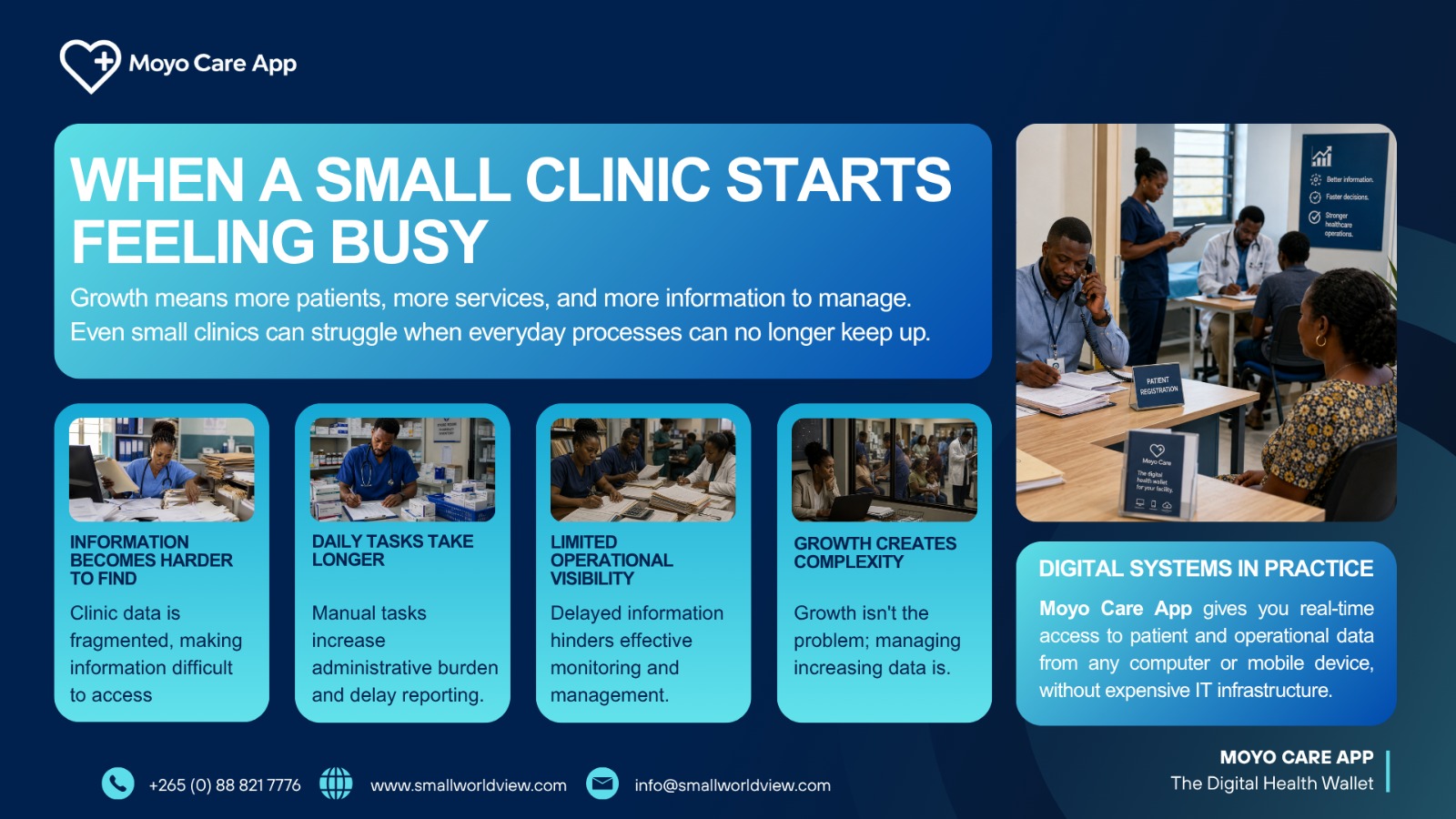
The issue is not that the clinic has become large. The issue is that the clinic has become busy.
Many healthcare facilities begin with a relatively simple operating model. A clinician, a nurse, a receptionist, and a manageable number of patients each day. Patient records are easy to locate, revenue can be tracked manually, and staff communicate directly because everyone works closely together.
In those early stages, formal systems may not appear necessary. The facility is small, the team is familiar with the patients, and most operational information is readily available.
Then, gradually, things begin to change.
Patient numbers increase. Additional staff members are hired. More insurance clients begin visiting the facility. New services such as laboratory testing, pharmacy dispensing, or minor procedures are introduced. None of these changes seem significant on their own, but together they create a level of operational activity that is very different from what existed a year earlier.
The clinic may still be considered small, yet it no longer operates like one.
One of the first signs is that information becomes harder to manage.
Questions that were once easy to answer now require investigation. How many patients were seen this week? Which insurance claims are still awaiting submission? Which medicines need to be reordered? How much revenue was collected yesterday?
The information exists somewhere, but gathering it often requires checking multiple registers, spreadsheets, receipt books, and notebooks.
At the same time, staff become busier. Activities that once relied on memory, verbal communication, or manual tracking become more difficult to coordinate consistently. Small delays begin appearing throughout the day. Administrative tasks take longer. Reporting becomes more challenging.
The issue is not that the clinic has become large. The issue is that the clinic has become busy.
Many healthcare facilities wait until operational challenges become significant before considering digital systems. By that stage, inefficiencies may already be affecting productivity, visibility, and service delivery.
The most effective facilities often take a different approach. They recognize that digital systems are not only tools for large hospitals. They are operational tools that help organizations manage information, maintain visibility, and support growth regardless of size.
A clinic does not need thousands of patients to benefit from structured information management. It simply needs enough activity that information starts becoming difficult to manage manually.
In many cases, that point arrives much sooner than expected.
Many small and medium-sized healthcare facilities are adopting digital platforms to strengthen daily operations without investing in complex technology infrastructure.
Moyo Care App is a ready-to-deploy hospital management system and electronic medical record platform designed for clinics and hospitals of different sizes. Because the system is cloud-based, facilities do not require dedicated servers, internal networks, or extensive IT resources. Staff can access the platform using internet-connected computers or mobile devices, making implementation practical even for smaller facilities. The system can be configured to align with existing workflows and supports integration with participating health insurance systems, helping reduce dependence on paper claim forms while improving operational visibility.
In the next article, we explore a challenge that many healthcare facilities eventually encounter:
The Clinic Runs Well Until Someone Is Absent