
Published by Moyo Care - 7 April 2026
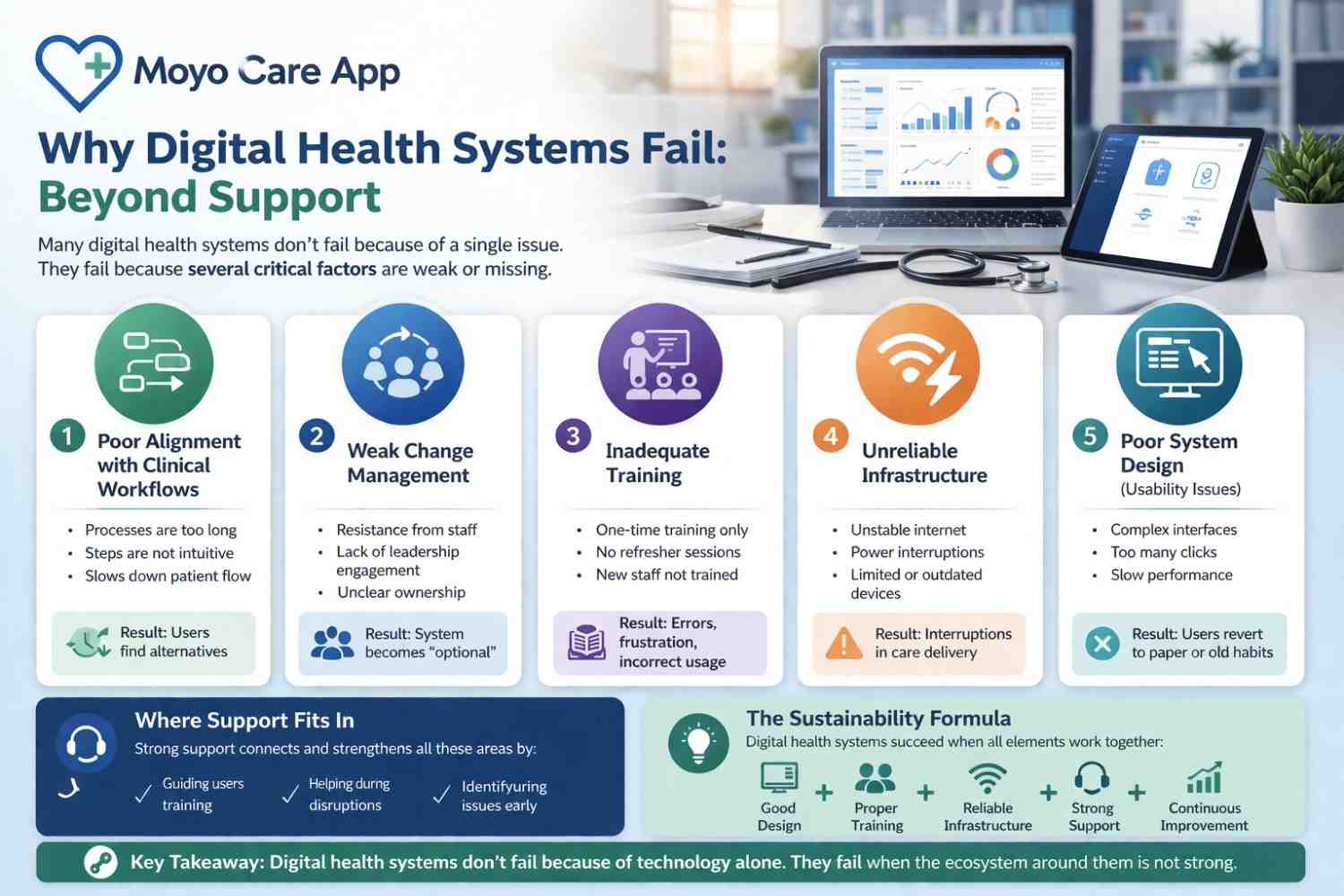
Digital health systems rarely fail because of one issue alone. They fail when multiple weaknesses around the system gradually undermine trust, use, and sustainability.
In our previous article, we explored how the lack of system and user support can lead to the failure of digital health systems.
While support plays a critical role, it is only one part of a much bigger picture.
Many digital health systems fail not because of a single issue, but because of a combination of weaknesses that gradually undermine their use over time.
To truly sustain digital care systems, we must look beyond support and understand the broader ecosystem required for success.
Digital health systems are often introduced with strong expectations. They are designed to improve efficiency, enhance patient care, and streamline operations.
However, once deployed in real-world settings, gaps begin to emerge.
These gaps are rarely caused by technology alone. Instead, they arise from how the system fits within the environment it is meant to serve.
A system may be technically sound but still fail if it does not align with how healthcare workers operate.
If processes are too long, steps are not intuitive, or tasks slow down patient flow, users will naturally look for alternatives.
In busy clinical environments, speed and simplicity are essential. When a system disrupts this, it becomes a burden rather than a tool.
Introducing a digital system is not just a technical change. It is a cultural shift.
Without proper change management:
When a system is seen as optional, it quickly becomes underutilized.
Training is often treated as a one-off activity during system rollout.
In reality, staff turnover is common, users forget processes over time, and new features are introduced.
Without continuous training and refresher support, users begin to:
Even the best-designed system cannot function without a reliable environment.
Challenges such as unstable internet connectivity, power interruptions, and limited or outdated devices can disrupt system use and frustrate users.
When access is inconsistent, confidence in the system declines.
If a system is difficult to use, adoption will suffer.
Common usability issues include:
Healthcare workers operate under pressure. A system that adds friction will quickly be abandoned in favor of faster alternatives.
While these challenges may seem independent, they are closely connected.
Strong system and user support plays a unifying role by:
Support does not replace these foundational elements, but it strengthens them.
Consider a facility implementing a digital system where workflows are not fully aligned, staff received limited training, internet connectivity is unstable, and no support is available when issues arise.
In this scenario, the system is unlikely to succeed.
Now imagine the same environment with strong support. Users receive guidance in real time, workarounds are provided where needed, and feedback is collected and used to improve the system.
The outcome is completely different.
For digital health systems to succeed, several elements must work together:
Sustainability is not driven by one factor. It is the result of a balanced ecosystem.
Digital health systems do not fail because of technology alone.
They fail when the environment around them is not designed to support their success.
As we continue to build and scale digital health solutions, the focus must shift from deployment to sustainability.
Understanding the broader reasons for system failure allows us to design better, support better, and ultimately deliver better care.
In the next article, we will explore why the first 90 days after implementation are critical in determining whether a system succeeds or fails.