
Published by Moyo Care - 30 March 2026
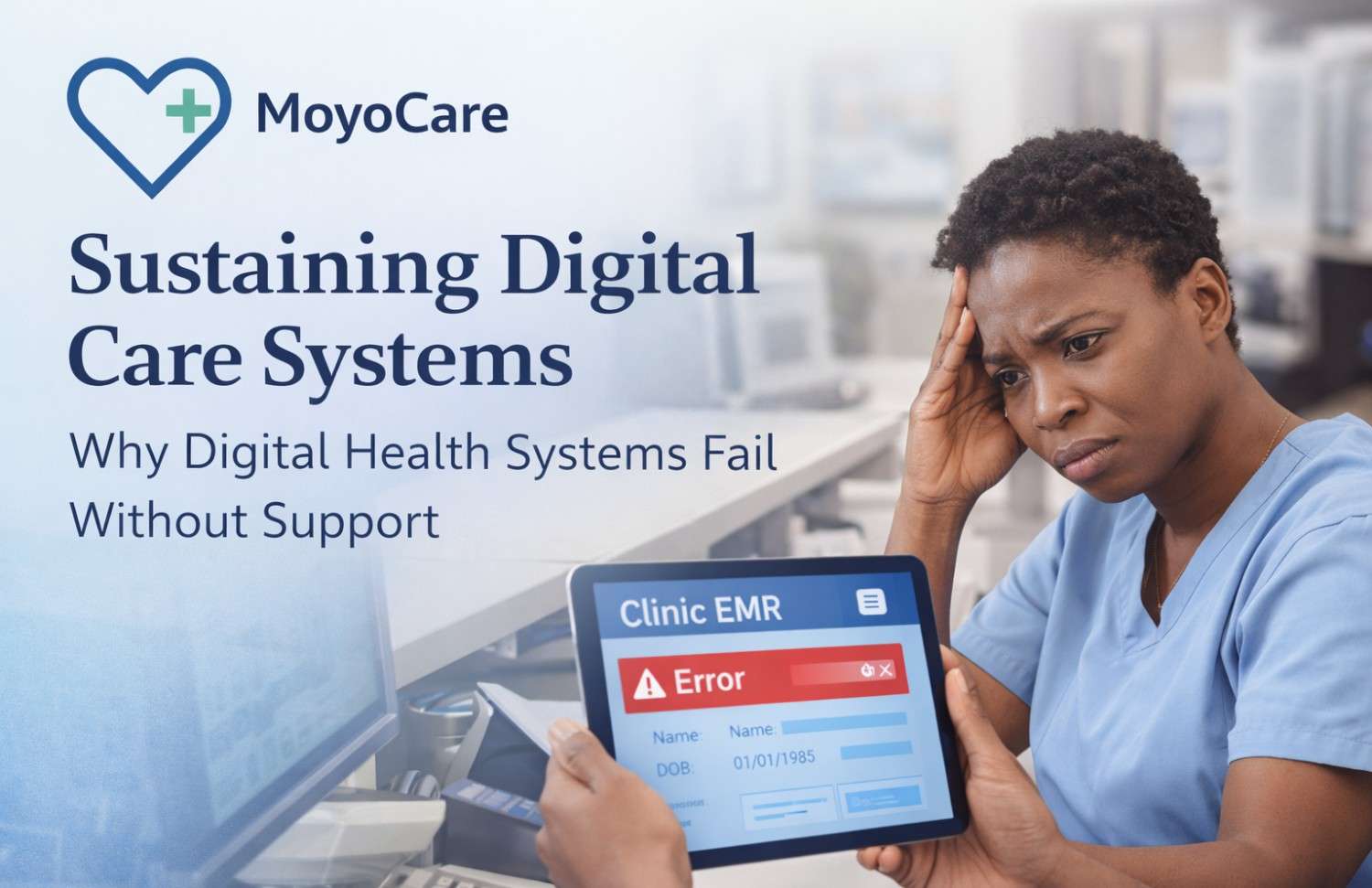
Many digital health systems do not fail because the technology is weak. They fail because the people using them are not adequately supported.
Across many healthcare systems, digital solutions such as Electronic Medical Records, billing systems, and clinical workflow tools are introduced with high expectations. They promise greater efficiency, better patient care, stronger reporting, and improved financial management.
Yet despite these benefits, many systems struggle to achieve long-term use.
The problem is rarely the technology itself.
More often, it is the lack of adequate system and user support that leads to failure.
There is a widespread belief that once a digital system is installed and staff are trained, the system will run smoothly on its own.
In reality, healthcare environments are constantly changing. Staff change. Workflows evolve. Systems encounter real-world edge cases that may not have been obvious during development or training.
Without ongoing support, even a well-designed system begins to break down in practice.
When support is limited or delayed, small issues quickly become major barriers.
A receptionist who cannot process a patient because of a system error may delay the patient, revert to paper, or lose trust in the system altogether.
A clinician who is unsure how to capture a diagnosis may skip the step, enter incorrect data, or affect downstream reporting and claims.
Over time, these small breakdowns lead to larger operational problems:
Eventually, the system is seen as unreliable, even when the original technology remains sound.
Digital health systems are not used by machines. They are used by people.
Healthcare workers operate under pressure, often with limited time, heavy workloads, and high patient volumes. When they encounter friction, they do not just need instructions. They need quick answers, reassurance, and practical solutions in real time.
Support provides that safety net.
It transforms uncertainty into confidence and helps users continue working without losing trust in the system.
Support should not be treated as an afterthought or an optional add-on.
It is as important as the system itself, the internet connection, and the clinical workflow around it.
Strong support helps ensure:
Without support, even strong systems become fragile. With support, users are able to keep moving, solve problems quickly, and build confidence over time.
Consider a facility processing insured patients.
If staff encounter a problem during verification or billing and no support is available, the process may revert to manual handling. Claims may be delayed or lost. Patients may lose confidence in the facility and the digital process.
But when timely support is available, the issue can be resolved immediately, the patient can be served without delay, and the claim can continue through the digital workflow.
The difference is not the system.
The difference is the support around it.
Even well-built digital health systems will fail if users are not supported.
As healthcare continues to digitize, the focus must shift from simply deploying systems to sustaining them.
And sustainability starts with support.
In the next article, we will explore Why Digital Health Systems Fail: Beyond System and User Support.